Wednesday, July 20, 2011

Liberators & Prophets


Elizabeth Cady Stanton (1815–1902) was an American social activist, abolitionist, together with her husband, Henry Brewster Stanton and cousin, Gerrit Smith, and leading figure of the early woman's movement. Her Declaration of Sentiments, presented at the first women's rights convention held in 1848 in Seneca Falls, NY, is often credited with initiating the first organized women's rights and women's suffrage movements in the United States. Unlike many involved in the woman's rights movement, Stanton addressed various issues pertaining to women beyond voting rights, including women's parental and custody rights, property rights, employment and income rights, divorce laws, the economic health of the family, and birth control. She was also an outspoken supporter of the 19th-century temperance movement.


Amelia Jenks Bloomer (1818-1894) was an American women's rights and temperance advocate. Even though she did not create the women's clothing reform style known as “bloomers”, her name became associated with it because of her early and strong advocacy.


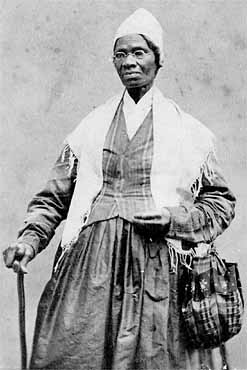
Sojourner Truth (c. 1797-1883) was born with the name Isabella Baumfree. When she was 46 in 1843, after she’d gone east, she stopped at a Quaker farm to ask for a drink. When asked her first name, she replied “Sojourner”, and when asked her last name, she said: “The only master I have now is God, and His name is Truth.” She was an African-American abolitionist and women's rights activist. Truth was born into slavery in Swartekill, NY, but escaped with her infant daughter to freedom in 1826. After going to court to recover her son, she became the first black woman to win such a case against a white man. Her best-known extemporaneous speech on racial inequalities, “Ain't I a Woman?”, was delivered in 1851 at the Ohio Women's Rights Convention in Akron, OH. During the Civil War, Truth helped recruit black troops for the Union Army; after the war, she tried unsuccessfully to secure land grants from the federal government for former slaves.


Harriet Ross Tubman was born Araminta Ross (1822-1913) was an African-American abolitionist, humanitarian, and Union spy during the American Civil War. After escaping from slavery, into which she was born, she made 13 missions to rescue more than 70 slaves, using the network of antislavery activists and safe houses known as the Underground Railroad. She later helped John Brown recruit men for his raid on Harpers Ferry, and in the post-war era struggled for women's suffrage. As a child in Dorchester County, MD, Tubman was beaten by masters to whom she was hired out. Early in her life, she suffered a head wound when hit by a heavy metal weight. The injury caused disabling seizures, narcoleptic attacks, headaches, and powerful visionary and dream activity, which occurred throughout her life. A devout Christian, Tubman ascribed the visions and vivid dreams to revelations from God. In 1849, Tubman escaped to Philadelphia, then immediately returned to Maryland to rescue her family. Slowly, one group at a time, she brought relatives out of the state, and eventually guided dozens of other slaves to freedom. Traveling by night, Tubman (or "Moses", as she was called) "never lost a passenger". Large rewards were offered for the return of many of the fugitive slaves, but no one then knew that Tubman was the one helping them. When the Southern-dominated Congress passed the Fugitive Slave Law of 1850, requiring law officials in free states to aid efforts to recapture slaves, she helped guide fugitives farther north into Canada, where slavery was prohibited. When the American Civil War began, Tubman worked for the Union Army, first as a cook and nurse, and then as an armed scout and spy. The first woman to lead an armed expedition in the war, she guided the Combahee River Raid, which liberated more than 700 slaves in South Carolina. After the war, she retired to the family home in Auburn, NY, where she cared for her aging parents. She became active in the women's suffrage movement in New York until illness overtook her. Near the end of her life, she lived in a home for elderly African-Americans that she had helped found years earlier.


+     +    +    +    +    +


Each of these women, in her own way, was an outstanding steward of God’s gracious gifts and used them to serve humankind. They all accomplished what they did “with the strength that God supplies.” Despite so many indignities and injuries heaped upon most of them, they responded with the generosity of the friend in today’s Gospel. Their courageous faith enabled them to keep asking, searching, and knocking on the doors of all who would listen to their persistent calls for freedom, justice, and equality for all God’s children.

Monday, July 18, 2011

Protector of the Indies


1484   Born in Seville to Pedro de Las Casas, a small merchant wealthy enough to send his son to learn Latin in the academy at the cathedral of Seville in 1497. He studied both theology and law at the University of Salamanca.


1502   Leaves Spain for Hispaniola in the West Indies with the governor, Nicolas de Ovando. He earns an encomiendaa royal land grant populated with native peoples of the Indies, for his participation in several expeditions and then proceeds to evangelize the Indians.


1506   Returns briefly to Europe where he is ordained a deacon in Rome.


1511   On August 15, Pentecost Sunday, listens to a sermon by a Dominican priest, Father Antonio de Montesinos on the text "I am a voice crying in the wilderness," denouncing Spain's treatment of the Indians. As a result Las Casas returns his Indian serfs to the governor, urges other Spanish colonists, in his own preaching to do likewise, and spends the rest of his life in defense of the Indians.


1512   Becomes first priest to be ordained in the New World at Santo Domingo.


1513   Takes part in the violent and bloody conquest of Cuba and receives Indian serfs for his efforts.


1515   Returns to Spain to plead the Indian cause before King Ferdinand. Gains the support of the archbishop of Toledo, Francisco Jimenez de Cisneros, who names Las Casas as priest-procurator and "Protector of the Indies".


1516   In November returns to America as a member of a commission sent to investigate the treatment of the Indians.


1519   Returns to Spain once more.


1520   Presents a defense of the Indian to King Charles I (Emperor Charles V), arguing that the time of military conquest of the Indians has passed and that they could be converted by more peaceful means. After much debate the king sides with Las Casas and supports his plan to build a colony of farm communities in present-day Venezuela inhabited by both Spanish and free Indians. Las Casas sets sail in December.


1522   In January, after more than a year of continuous opposition of local encomenderos who incite Indian attacks on the farmers, the experiment fails.


1523   Disappointed in the results of his political activities, Las Casas joins the Dominicans in Santo Domingo and focuses his energy on writing. Over the next several years he writes several works including the treatise Concerning the Only Way of Drawing All Peoples to the True Religion and the beginnings of both Apologetica Historia de las Indias and Historia de Las Indias.


1530   Returns to Spain and obtains a royal decree prohibiting the enforcement of slavery in Peru, which he delivered personally.


1537   Receives some support from the Pope in the form of Paul III's bull Sublimis Deus, declaring the American Indians as rational beings with souls and the need for their lives and property to be protected.


1542   Returns to Spain where he convinces Charles I to signs the "New Laws" prohibiting Indian slavery: an attempt to put an end to the encomienda system by limiting ownership of serfs to a single generation. Writes his most influential and best known work, A Brief Account of the Destruction of the Indies, although it is said to be filled with inaccuracies. The report horrifies the court.


1544   To ensure enforcement of the laws he is named bishop of Chiapas in New Spain and sets sail in July. Upon arrival meets immediate opposition. Declares, in his tract Confesionario, that any Spaniard who refuses to release his Indians is to be denied absolution. Many members of the clergy refuse to follow this order. A year later the inheritance limitation is rescinded by Charles V.


1547   Returns to Spain and renounces his position as bishop of Chiapas, and becomes an influential figure at court and at the Council of the Indies. Begins conflict with Juan Gines de Sepulveda who defends Spain's treatment of the Indians on Aristotelian principles.


1550   At the order of Charles I he meets Sepulveda in the famous debate at the Council of Valladolid. While Las Casas convinces the theologians who preside over the debate and receives official approval, Sepulveda's teachings largely prevail in the Indies.


1552   Without clearance from the Inquisition, Las Casas publishes The Destruction of the Indies. Spends the next 14 years writing and appearing at court and councils in defense of the Indians.


1566   Dies in Madrid on July 18, and is buried in the convent chapel of Our Lady of Atocha.


1875   Historia de las Indias first published.


Blessed Bishop William White (1747-1836)


O Lord, in a time of turmoil and confusion you raised up your servant William White, and endowed him with wis- dom, patience, and a reconciling temper, that he might lead your Church into ways of stability and peace: Hear our prayer, and give us wise and faithful leaders, that through their ministry your people may be blessed and your will be done; through Jesus Christ our Lord, who lives and reigns with you and the Holy Spirit, one God, for ever and ever. Amen.

Sunday, July 17, 2011

Priorities: Wheat Or Weeds?


Today we continue reflecting on Jesus’ parables of the reign/rule of God, traditionally called the kingdom, or as my pastor, Fr. Daniel Green, calls it, “the empire of heaven”. He identifies that as the sharing in “...the new life in the Spirit, the indwelling power of the God who raised Jesus from the dead,...not just  a ‘religious idea’  [but] a reality...
Just as last week,  the theme of the Gospel (Matthew 13:24-30; 36-43) is one of sowing seed. Matthew inserts a parable, found only in his Gospel, which we call the parable of the wheat and the tares/weeds. (The Greek word for weeds, by the way, is very descriptive: zizánia.) This parable likens the reign of God to someone sowing good seed in a field. The "someone", the sower, is a householder, with slaves who work his fields: obviously, a man of some status and wealth by ancient standards.  As any good farmer, he sows "good seed" in his field: something useful and beneficial, in this case, seed that will produce good fruit. That’s also a common way of describing, in the Gospel, someone who walks in the ways of God.  By extension, then, it refers to anyone who acts in a praiseworthy or noble way: in ancient terms, a person who leads a good, moral life.
An enemy comes along and sows weeds among the wheat.  The New International Version, as well as other commentators, include the pronoun "his enemy", probably more accurate here.  This isn’t a random enemy; this is personal.  Note, however, what Jesus says earlier in Matthew (5:43-45): "...I say to you, Love your enemies and pray for those who persecute you, so that you may be children of your Father in heaven; for he makes his sun rise on the evil and on the good, and sends rain on the righteous and on the unrighteous...". This may offer some insight into the householder's response to the situation. Again, in Chapter 10, Matthew’s Jesus reminds us: "...one's foes will be members of one's own household", indicating possible conflict even within a domestic household as a result of following Jesus.  Therefore, it’s not too much of a stretch to liken it, by extension, to conflict created by brothers and sisters in Christ within the “household of the faith”.
The focus of Jesus’ message becomes clear in the exchange between the householder and his slaves.  The householder recognizes rather quickly who’s responsible for the weeds, but we hear nothing more about the enemy.  When the slaves ask whether the weeds should be pulled up, the householder instructs them to let the weeds grow alongside the wheat until the harvest.  That may seem puzzling to many.  What if the weeds, like the thistles in last Sunday’s parable, choke out the wheat? Possibly, yet the householder holds back for fear that some of the good wheat might be uprooted in the process of destroying the weeds. Which leaves the wheat, whom Jesus later refers to as “the children of the kingdom”, in a precarious position. It means they have to rub shoulders day after day with people who clearly don’t associate themselves with Jesus. Nevertheless, the passage quoted above from Matthew 5, about God sending the sun and rain on both the righteous and the unrighteous, indicates God’s unlimited generosity of spirit. Can the householder, or we, do anything less?
Jesus’ explanation of this parable is separated from the parable itself by two additional parables: those of the mustard seed and of the yeast in the flour. Like the parable of the wheat and weeds, they deal with growth.  They may be Matthew’s way of encouraging a beleaguered Christian community, beset by weed-like antagonists.  The parables also witness to the presence of God’s reign/empire, i.e., God’s presence through Jesus, in the power of God’s Spirit of Love, even though, in practice, you and I are often quite challenged to actually see it.  Possibly it’s also a comment on the wheat and the weeds: perhaps the householder’s concern, as so often in our lives, is that it’s not all that easy sometimes to figure out what is wheat and what is a weed, both in the kingdom and even within our own selves.
Matthew notes that “Jesus told the crowds all these things in parables; without a parable he told them nothing...”  quoting the words of the Hebrew prophet Asaph in Psalm 78. Twelve of the Psalms, 50 and 73-83, are attributed to Asaph, the son of Berechiah, who, along with his four sons, were assigned by King David to prophesy “to the accompaniment of lyres, harps and cymbals”. (1 Chronicles 25:1-2)  This is a transition point, as Jesus leaves the crowds behind and enters a house.  Even as, in last Sunday’s Gospel passage, Jesus left the security of a house in order to go out and speak a parable to the crowds, so now Matthew pictures Jesus returning to that safe haven, where He gathers only his circle of disciples to hear firsthand his unfolding of the parable. As Jesus had said to them earlier when he’d explained the sower parable: “To you has been given to know the secrets of the kingdom of heaven, but to them it has not been given…” The crowds are left standing outside to think about the implications of the parable of wheat and weeds which they’d just heard, to evaluate what it meant for them personally.   Note, however, the curious question of the disciples to Jesus: “What is the explanation of the parable of the weeds in the field.” The parable itself says that the householder was most concerned with the wheat
Jesus identifies the sower of the wheat as “the Son of Man”.  In Matthew, that title refers to Jesus in his earthly ministry: for example, “...that you may know that the Son of Man has authority on earth to forgive sins...” (9:6);  “...the Son of Man came eating and drinking...” (11:19); and “...the Son of Man will be handed over to the chief priests and scribes...” (20:18).  “Son of Man”, in Matthew, can also refer to the One who comes to judge: for example: “...when the Son of Man is seated on the throne of his glory...judging the twelve tribes of Israel...”  (19:28); and “...When the Son of Man comes in his glory...all the nations will be gathered before him, and he will separate people from one another...” (25:31).   
Matthew seems to have both roles in view in this explanation of the parable. The good seed is identified with “the children of [God’s] kingdom”, while the weeds are identified as “children of the evil one”.  What Matthew identifies as evil throughout his Gospel account is, in one way or another, whatever breaks trust: the very basis for human relationships. By extension, that becomes an even more important element regarding one’s relationship with God and one’s sisters and brothers in Christ.
The harvest is a common image for judgment accompanying the end of the ages. References to the furnace of fire conjure up both images of destruction and the refiner's fire.   As the weeds are gathered at the end of the harvest, so the Son of Man will gather out of the whole world, "all causes of sin and all evildoers."  The New American Standard Version translates the latter as: "all stumbling blocks and those who commit lawlessness." (anomia - “no guidelines”)  The word for stumbling blocks, in Greek = skandala, hence, our English word "scandal."  It means those who create obstacles, who severely tempt or test others.  Jesus’ observation in Matthew 5:19 aptly describes a person who’s a stumbling block and who lives according to no guidelines, when he depicts Jesus saying: "...whoever breaks one of the least of these commandments, and teaches others to do the same, will be called least in the kingdom of heaven...."  That suggests that until God renders judgment, you and I will, for the time being anyway, still run into stumbling blocks of all sorts in the kingdom.
But for those disciples, his own and those among us today, who are so preoccupied about the weeds rather than the wheat, perhaps Jesus wants to reassure them and us, too, that, in the end, all causes of stumbling will be swept away.  Utterly dependent as we are on grace, we can, with surest confidence, trust God's righteousness, which ultimately requires God’s judgment, but whose other side is always mercy upon mercy. Naturally, we just prefer that judgment when it’s others who are judged, not ourselves! The parable of the wheat and the weeds reminds us that, in the meantime, we all continue to grow together, side by side, and that it isn’t your business or mine to figure out who belongs to which category. Our task is simply to be faithful in living as a child of the reign, the kingdom of God.
Several questions suggest themselves for you and me to think about this coming week, as we continue to be challenged by events which surround and affect us: the serious situation of the political wrangling over the debt ceiling in our country, while countless of our citizens go jobless, homeless, hungry and without medical coverage; another upcoming pre-election “circus”; the endless wars which continue to sap our country’s resources and our women and men in the military; the various current concerns of this parish; and all of our own personal daily concerns.  

- As a disciple of Jesus trying to discern how you might be able to cope, what is your priority: the wheat or the
  weeds?   
- What things or people are stumbling blocks for you and me, and for whom are you or I stumbling blocks?  
- What can you and I do to live more faithfully as committed children of God’s reign/kingdom?
...For all who are led by the Spirit of God are children of God...When we cry, ‘Abba! Father!‘ it is that same Spirit bearing witness with our spirit that we are children of God, and if children, then heirs, heirs of God and joint heirs with Christ -- if, in fact, we suffer with him so that we may also be glorified with him…” (Romans 8:14-17)

Saturday, July 16, 2011

Commemoration of Our Lady of Mt. Carmel


July 16 is the principal feast day of the Order of Carmel, sometimes called "the feast of the Scapular". A groups of hermits living on Mt. Carmel, through the efforts of a Crusader, Berthold, were organized into an Order around the year 1150. Gradually, the monks migrated to Europe because of oppression by the Saracens. The Mother of God is said to have appeared to Pope Honorius III during the night preceding July 16, 1225, and urged him to approve the foundation of the Order. Since the Carmelites were still experiencing continual harassment, St. Simon Stock, 6th General of the Order, besought the Mother of God for some special sign of her protection. It is said that on July 16, 1251, Mary designated the scapular as a special mark of her maternal love. Many Orders use a scapular as part of their religious habit, but it's a distinctive and special feature of the Carmelites. Non-members, associated with the Order, often wear a smaller version of the scapular as a sign of their solidarity with the Carmelite spirit of devotion to Our Lady of Mt. Carmel.


Loving God, who honored the Order of Carmel
with the special title of the most blessed Virgin Mary,
your mother, graciously grant, that we who today
honor her commemoration with solemn devotion, 
defended by her care, may be found worthy
to attain everlasting happiness. Amen.


The Seraphic Doctor - St. Bonaventure (c. 1218-1274)

"Doctor", for most of us, generally means one of two things: a white-coated person devoted to medicine and the healing of the human body, or a wise figure from academe. In the history of the Church it has a unique meaning. A doctor vitae is one who's not only book-wise and knowledgable, but especially one who lives well, a teacher of life. There are well over 30 Doctors of the Church, both men and women. 


A Doctor of the Church is a model for all followers of Jesus in two things: teaching and listening. Through the Christian tradition, i.e., the "handing-down" of the faith from Christ and the Apostles, through their successors, the bishops, and through other clergy, priests and deacons, the Church is taught. Perhaps more importantly, the faith is conveyed through the non-ordained members of the Church. Note that the Book of Common Prayer (p. 855) lists as "the ministers of the Church" first "lay persons", then bishops, priests and deacons. Parents and teachers, especially, but also all those who have been gifted with helping others to grasp and live the teachings of Jesus, either formally or informally, share in the teaching ministry. In this regard the declared Doctors of the Church have distingished themselves through the centuries. There's a delicate interplay between the Ecclesia docens = the teaching Church, and the Ecclesia discens = the taught Church.


Secondly, a Doctor of the Church reminds us that both those teaching and those taught need to listen: not just hear, but listen with humble receptivity. All of us in the Church listen, not only by taking in what our instructors in the faith teach us, but also by feeding our minds and spirits with the riches of Holy Scripture, with the spiritual classics of our Christian tradition, and even with homilies/sermons in the liturgy, though these are often subject to mixed reviews!


Bonaventure was a unique personality. Born in Bagnoreggio, Italy, he became a Franciscan friar in 1243. He asssociated with some of the "greats": St. Francis of Assisi interceded for his cure from a serious illness when he was a young boy. He met St. Thomas Aquinas while they were students at the University of Paris, and, in fact, they received their Th.D's together in 1257. While Thomas became the herald of Scholasticism, based on Aristotle's philosophy, Bonaventure became the principal leader of the Platonic-Augustinian school of Franciscan thought, and, as such, was opposed to the inroads which Scholasticism was making in the schools of the time. 


Bonaventure exhibited great holiness of life, wisdom, eloquence in preaching, remarkable skill in getting things done, a loving heart, a charming disposition, and many other natural gifts which drew people to him. He was unparalleled as a teacher and preacher, and at age 36 he was elected as Minister General of the Franciscan Order, and virtually refounded it. Bonaventure had great love and respect for St. Francis, but he disagreed with Francis regarding study and the possession of books (a man after my own heart!). "...He clearly saw, with Francis, that the role of the Friars was to support the Church through its contemporary structures rather than to be an instrument for reform. He also believed that the best conversions came from the good example of those anxious to renew the Church, rather than by haranguing or passing laws..." (Celebrating the Saints, p. 236-237)


The Pope chose Bonaventure in 1265 to become the Archbishop of York, but Bonaventure eventually begged off being consecrated. In 1273, however, having helped in Gregory X's election to the papacy, Bonaventure was made Cardinal-Bishop of Albano.  He was an important figure at the Council of Lyons in May, 1274, attending four sessions before his untimely death at age 56 that year.


Through the centuries, Bonaventure became known as The Seraphic Doctor, particularly in view of his profound mysticism. In this both he and Thomas Aquinas inspired many people, both in their own time and in succeeding generations. In summary, Bonaventure's contemporaries are said to have believed that there was no one "more handsome, more holy, or more learned" than he. 


Wednesday, July 13, 2011

"Model of the Gospel's Perennial Youth"


Juana Enriqueta Josefina de los Sagrados Corazones Fernandez Solar, "Juanita" to her family and friends, was born to Lucía Solar Armstrong and Miguel Fernández Jaraquemada, wealthy aristocrats, in Santiago, Chile, on July 13, 1900, the third daughter of a family of seven children. Juana was drawn to God early on, around the age of 6, according to her diary: "when Jesus began to take my heart to be His own". She was no "saint" personality-wise at first, displaying evidence of pride, vanity, self-centeredness, and stubbornness, some of it influenced by her many illnesses.  She notes in her diary, which she kept until November, 1919: “God alone knows what it cost me to overcome this pride or vanity that took possession of my heart as I grew older. My character was timid, my heart sensitive…but my disposition was extremely gentle; I never used to get mad at anyone”, although she was quite aware of her fierce temper and predisposition to anger. In time, by God's grace, she developed a remarkable determination to overcome these shortcomings.
Juana was educated under the supervision of the Religious of the Sacred Heart. She was confirmed in 1909 and received First Communion the next year.  With a child's comprehension of what it meant for God to dwell in her, she worked for a whole year to prepare herself for this important day in her life, September 11, 1910, “the centenary year of my country.” That very day, she notes, she "experienced His dear voice for the first time... Since that first embrace, Jesus did not let me go but took me for Himself."
Nevertheless, Juanita, coming as she did from a large family, joined in normal activities similar to any child growing up: games of hide-and-seek and catch-the-flag, kite-flying, swimming, horseback riding, even referring in her diary to a “flirtation”, though not a serious one, with a boy. She speaks, in her diary, of the challenges of adolescence: “October 3. [1917] I don’t know what to do with regard to mortifications, since the priest told me I shouldn’t do any, but I’ve such an unusual craving to eat caramels. Today I had such hunger that I ate all those I could and the ones that tasted best. It pains me to see that this is the way I am. Truly I don’t know what to do…” When she was 18 she wrote about her emotions and even depression: “April 10. I’m in a terrible state... Angry. With desires to be mischievous. Mad at the nuns. Without taste for prayer, because I encounter dryness in it. I feel despondent...And Jesus told me today that it was because I was attached to creatures. I want to be loved by them. I cry because I don’t know what is happening to me and I have no one to counsel me or help me. Mother Izquierdo was angry and that is tormenting me…
Juana felt called, as early as age 14, to devote her life to God as a Carmelite. She had read the autobiography of St. Thérèse of Lisieux [herself canonized a saint five years after Juana’s death] that year, and continued reading the works of the great Carmelites: Teresa of Avila, Elizabeth of the Trinity, and even some of John of the Cross. The next year, 1915, she took a vow of virginity for 9 days, with her confessor's permission, renewing it periodically as he deemed it appropriate. She shared her determination to become a Carmelite with her younger sister, Rebecca, who, after Juana’s death, also followed Juana into the Los Andes Carmel, in November, 1920. In the fall of 1917 Juana wrote to Mother Angelica, Prioress of the Discalced Carmelite Monastery of the Holy Spirit in the town of Los Andes (Santa Rosa de Los Andes), expressing her desire to become a Carmelite, and again in the fall of 1918, asking to be admitted. 
The Prioress concurred, and Juana’s mother accompanied her on the morning express train to the Monastery on January 11, 1919. The admiration between Juana and the Carmelite community was mutual. At the end of March Juana wrote to her father, who was away, asking his permission to enter the Carmelites. She anguished over it, but was relieved when her mother received a note from Don Miguel, hinting that, though he wasn't opposed to it, he wanted to give it further thought. Three days later, he gave his permission despite his misgivings about the choice. 
On May 7, 1919, Juana entered the Carmelite Monastery of the Holy Spirit at Los Andes as a postulant, taking the name Teresa of Jesus. On May 14, 1919 she wrote: "...I’m now in Carmel 8 days. Eight days of heaven. I feel divine love in such a way that there are moments when I believe I'm unable to endure it. I want to be a pure host and continually sacrifice myself for priests and sinners." That inner happiness continued until her premature death. Her wish to "sacrifice myself" was certainly answered in the short time she remained alive, for she underwent immense suffering, not only physically, but interiorly: homesickness; worry for her family, especially her brother, Miguel; doubts concerning faith; spiritual dryness, etc.  She was clothed in the Carmelite habit on October 14, receiving the white veil [see left photo above], and began her novitiate.  
Already at the beginning of 1920, Teresa fell ill with typhoid fever.  Early in March she predicted to her confessor, Fr. Avertano, that she would die within a month. On Holy Thursday, April 1, and most of Good Friday, April 2, she participated in choir, but because of a high fever she was sent to bed by the Novice Mistress. Her condition worsened over the next four days. Her mother arrived, and Teresa was given the Last Rites on April 6, and received Communion for the last time on April 7. With death imminent, Teresa was dispensed from the remaining time of her canonical novitiate and allowed to make her vows as a Carmelite the same day. [Note: Teresa didn’t actually receive the dark veil, though she’s wearing one in the right photo above. At that time it was customary to have photographs taken before a woman entered the monastery, since photographic equipment wasn’t allowed in the monastery. One copy of the photos was sent to the monastery, and one copy was sent to the woman’s family as a memento. The habit which Teresa is wearing was borrowed from Sister Carmel of St. Francis Xavier, OCD, a nun at the Carmelite Monastery of St. Joseph, in Santiago.] Five days later, on April 12, she died, three months shy of her 20th birthday. Her funeral and initial burial in the monastery cemetery took place two days later, April 14.
In March, 1986, two years after her last sibling, Luis, died, Teresa was declared Venerable by Pope John Paul II. In April, 1987 he declared her Blessed, and on March 21, 1993 he canonized Blessed Teresita, as the people of her country affectionately refer to her, a Saint of the Church. Teresa is the first Chilean to be declared a saint, as well as the first Discalced Carmelite nun outside the boundaries of Europe to be named a saint. She is the fifth saint in the Carmelite Order with the name “Teresa”, along with Teresa of Avila, Thérèse of Lisieux, Teresia Benedicta of the Cross (Edith Stein), and Teresa Margaret of Florence). 
The present Sanctuary of Santa Teresa de Los Andes is located near the city of Los Andes in the area of Auco, from where you can see the whole Valley of Los Andes. Every year in October there is a traditional pilgrimage, attended by more than 160,000 people who come to venerate the Chilean saint. The trip is a long, hard walk of some 27 km, from the old Chacabuco ranch, which once belonged to Teresa’s grandfather, to the Sanctuary of Santa Teresa, during which the pilgrims pray, sing and dance. The Cathedral is dedicated to La Virgen del Carmen, and in the Crypt lie the remains of St. Teresa de Los Andes. The new Convent of the Discalced Carmelite Sisters, which was moved from Los Andes, is nearby. This great spiritual center, through the simplicity of its buildings and the natural beauty of the place, reflects the virtues of Teresa of Los Andes: simplicity, humility, happiness and peace.
St. Teresa of the Andes possessed an enormous capacity to love and to be loved, joined with extraordinary intelligence. God allowed her to experience his presence. Knowing him, she loved him; and loving him, she bound herself totally to him, even in the midst of many interior trials. The Church holds her up as a preeminent model for children and young adults, particularly women: a real person to whom they can relate.