Wednesday, April 11, 2012

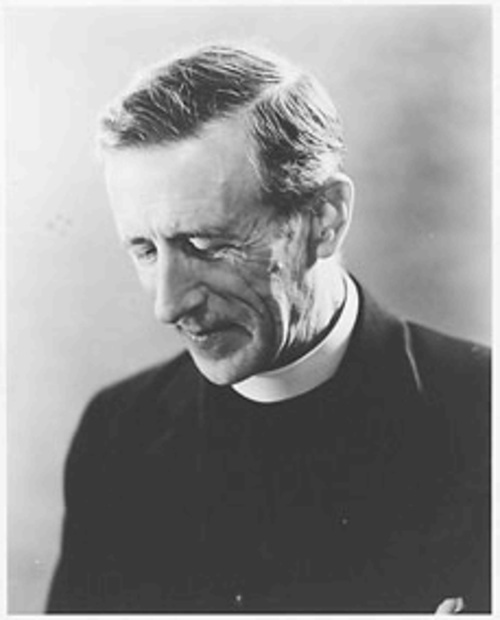
Teilhard de Chardin (1881-1955): Priest, Scientist, Theologian


Some of the saints' feasts get "lost" in the major celebration of the Resurrection of Jesus this first week after Easter. Nevertheless, a longtime "hero" of mine and of many others, I believe, deserves some attention.

Pierre Teilhard de Chardin was known to wrestle with questions: about life, about God, about nature and the universe. All his life he thirsted to know more and more about human beings and their world. For over 40 years Teilhard traveled the globe, to four of the seven continents, searching, digging, excavating. He sweated through the steaming jungles of Java and fought freezing winds across the barren wastes of China's Gobi Desert. Helping others to look beyond what the eyes can see, he gazed into the future, dedicating his life to making humanity's boldest hopes a reality.

Teilhard, as he was called, was born in the little village of Sarcenat in the south central French province of Auvergne on May 1, 1881. His father, Emmanuel Teilhard, was a wealthy gentleman farmer, archivist, and a man who had a taste for natural history, yet was very down-to-earth. Pictures show Teilhard and his family to be tall and slender people. An old Sacrcenat farmer once remarked: "I just met one of the little Teilhards -- eight years old and not more than six feet tall!

As a young boy Teilhard seemed unusually grown-up for his age. While only 6 or 7, he was busy acquainting himself with all of nature's elements, as he himself admits: "...you would have had to watch me as I withdrew, always secretly and without a word, without even thinking that there was anything worth saying about it to anyone, to contemplate, indeed, to possess, to savor the existence of my 'God Iron'. Yes, just that: Iron. I can still see with extraordinary clarity the whole series of my 'idols'. In the country a plough-key, in the town a hexagonal head of a metal staple, and later on little shell splinters which I collected lovingly on a nearby shooting range..."  His father encouraged his children in this, taking them for picnics and vacation trips, alerting them to the wonder of insects, plants and rocks.

Teilhard's mother, Berthe de Dompiere, was wise and religious. Teilhard later claimed that he owed to her all that was best in himself. At age 12 Teilhard entered the secondary school at Mongré. Though always a good student, he wasn't outstanding in religion, finding it difficult to adjust to the cut-and-dried manner in which it was taught. At age 17, in 1898, however, somewhat influenced by the philosopher, Maurice Blondel, he entered the Jesuit novitiate to study for the priesthood. Here Teilhard encountered a serious inner struggle in trying to reconcile the God "on high" of faith, adoration and love, with the God "in front", the God present in scientific research. "...The Cosmic Sense and the Christly Sense", he says, "definitely coexisted in my heart and irresistibly drew towards each other.

Having completed his studies in philosophy and theology in 1905 at age 24, he was sent to teach physics and chemistry in Cairo (Ismailia), Egypt, for three years, after which he went to Sussex, from 1908-1912, to complete studies in geology and paleontology. During this time he had his first realization of a movement from a "Less" to a "More" within the process of evolution. Teilhard's era was an age of science and discovery. Madame Curie had discovered radium. John Thomson and Ernest Rutherford uncovered the secrets of the electron and the atom. The Wright Brothers, fellow-citizens of my hometown, Dayton, OH, took to the sky for 59 dramatic seconds in 1903. And there were others: Peary, Marconi, Einstein, etc.

Teilhard de Chardin was ordained a Jesuit priest at Hastings in 1911, when he was 30 years old. He devoted the rest of his life to scientific teaching and research. During these years he became more and more involved in the science which was to be his life's focus: the evolution of the human being. He came across and was captivated by some of the ideas in Henri Bergson's L'Evolution créatrice (1907). Bergson held that matter is the degradation of energy of the creative élan vital, a sort of dead condensation-trail left behind by the movement of life. Teilhard, on the other hand, saw matter as life in its physico-chemical preconditions, sharing by anticipation in the vital upward movement of convergence of all things toward their final spiritual communion in the Pleroma, a scriptural concept of St. Paul's. Teilhard later met Abbé Henri Édouard Prosper Breuil (1877-1961), a French priest, archaeologist, anthropologist, ethnologist and geologist, noted for his studies in cave art in the Somme and Dordogne valleys, as well as in Spain, Portugal, Italy, Ireland, China, Ethiopia, British Somaliland and South Africa. It was Breuil who greatly influenced Teilhard to choose the evolution of the human being as his life's primary focus. 

By this time Teilhard had already done some excavating in Egypt, Spain and England. Questions of how life, especially human life, began intrigued Teilhard. For most folks in Teilhard's time, the Bible had long ago settled such queries. God created the world, then crowned God's work by creating man and woman, breathing into them "a living soul". This simple scriptural view was shored up by the teachings of Artistotle and St. Thomas Aquinas. Almost 20 years before Teilhard's birth, Charles Darwin had proposed a bold new theory of "natural selection". Animal groups or species, he said, develop through a very long, continuous process. The strongest and most fit survive longer and develop gradually into new groups. If this were true, it meant that human beings possibly derived from a well-developed animal form, such as a primate. The theory of evolution, predictably, raised quite a storm and most people of the time rejected it. Nevertheless, the thoughtful Teilhard felt that evidence generally favored the theory.

In 1914 World War I began, and Teilhard's studies were interrupted when he was drafted into the medical corps. He served as a stretcher-bearer and unofficial chaplain with the 4th Regiment of Zouaves and Light Infantry. Often in the thick of battle, he several times retrieved the wounded or dead under heavy fire. He was later given the Military Medal for heroism. In 1915, he was awarded the Croix de Guerre and promoted to the rank of Corporal. Throughout the war Teilhard continued thinking, writing, questioning. Even in the trenches he would study the geological deposits. He was determined to look beyond the evil and suffering around him to a richer future for the world and humankind which he perceived to be in a developing process.

By 1919, now 38, Teilhard had decided that professionally he would pursue a geological career, specializing in paleontology, and that as a priest he would strive to reconcile the facts of religious experience with those of natural science. Having received his Ph.D. in 1922, he taught geology at the Institut Catholique in Paris from 1922-1928. For a year, 1922-23, he served as President of the French Geological Society. In the spring of 1923 he set out on the first of many expeditions to China, writing about his increasing discoveries as he traveled, more than ever convinced that God was guiding the creative evolutionary process.

Teilhard returned to continue teaching in Paris in 1924, eager to share his findings. His research, he believed, confirmed that higher forms of life developed from simpler ones, and that creation has a purpose. He believed that the human being was becoming more intelligent, that both the world and humankind are moving toward greater unity, and that Christ stands at the center of all this. He was very much in tune with St. Paul's notion that Christ is the goal of creation and that in Christ all things and humankind will eventually be complete. Teilhard taught and spoke openly and honestly. Nevertheless, his "cosmic" views proved controversial to many and greatly disturbed his superiors. The latter considered Teilhard's ideas too unconventional to be commonly accepted, and feared that higher Church authorities would label him a heretic. At length the controversy became so heated that the Jesuit superiors forbade him to teach and asked him to leave Paris. It devastated Teilhard who was simply searching for the truth, yet now found his views and teachings under suspicion, not only by his own Community, but by the Roman Catholic Church as well. Obediently, he returned to China at his superiors' bidding, limiting his writings to the scientific domain and doing further scientific research. Teilhard's expressed his attitude during this difficult time: "I show by my example, that if my ideas are new, they make me no less faithful."

For almost 30 years, Teilhard de Chardin remained under the Vatican's cloud of suspicion, was barred from teaching in Catholic institutions, and had all his major works officially banned. Unfortunately, that continues, even to the present day. On June 30, 1962, the Holy Office issued a warning on Teilhard's writings: "Several works of Fr. Pierre Teilhard de Chardin, some of which were posthumously published, are being edited and are gaining a good deal of success. Prescinding from a judgement about those points that concern the positive sciences, it is sufficiently clear that the above-mentioned works abound in such ambiguities and indeed even serious errors, as to offend Catholic doctrine. For this reason, the most eminent and most revered Fathers of the Holy Office exhort all Ordinaries as well as the superiors of Religious institutes, rectors of seminaries and presidents of universities, effectively to protect the minds, particularly of the youth, against the dangers presented by the works of Fr. Teilhard de Chardin and of his followers." In 1981, on the centenary of Teilhard's death, Agostino Cardinal Casaroli, Vatican Secretary of State, issued a letter praising the "astonishing resonance of his research, as well as the brilliance of his personality and richness of his thinking." Casaroli asserted that Teilhard had anticipated John Paul II's call to "be not afraid," embracing "culture, civilization and progress." The media and other, in large part, interpreted this as implying that the warning against Teilhard's writings had been revised. The Vatican responded swiftly: "After having consulted the Cardinal Secretary of State and the Cardinal Prefect of the Sacred Congregation for the Doctrine of the Faith, which, by order of the Holy Father, had been duly consulted beforehand, about the letter in question, we are in a position to reply in the negative. Far from being a revision of the previous stands of the Holy See, Cardinal Casaroli's letter expresses reservation in various passages—and these reservations have been passed over in silence by certain newspapers—reservations which refer precisely to the judgement given in the Monitum of June 1962, even though this document is not explicitly mentioned." Officially, the warning stands to this day.


 Despite the flack Teilhard took, he continued his research up to the time of his death, wrote privately, was invited to be part of various projects and expeditions, and to travel the world: China, France, the U.S., Belgium, Somalia, India and Kashmir and South Africa, among other places.  It's virtually impossible to list all of the things Teilhard wrote during this 30-year period. There are simply too many of them, in various forms. The best one might do is point out some of his major works, all of which were published in English only after his death, largely because they'd been on the Catholic Church's ancient Index of Prohibited Books, generally referred to as "The Index". Also, much of his work was written and revised over many years. The following is a short list, in the order in which they appeared in English, not the order in which they were originally written: The Phenomenon of Man (1959); The Divine Milieu (1960); Letters From A Traveler (1962); The Future of Man (1964); Hymn of the Universe (1965); The Making of A Mind: Letters From A Soldier-Priest 1914-1919 (1965); Human Energy (1969); Activation of Energy (1970); Man's Place In Nature (1973).

Teilhard's own words at various times during his 30 years of being silenced can shed some light on his firm commitment to truth and to his work, regardless of the cost. Here are just a few:
"...I am at peace, really, with the Church and with God...Always tending towards what is to come, yet admitting that the new thing cannot be born except of fidelity to what is, I know find myself quite beyond revolt."

"I now feel more bound...to the Christ of the Gospel than ever before in my life."

"How can I stop without failing in my most urgent duty to God and man?...I have decided to continue as before, trusting to the legitimacy of my cause. I know that that is what all the heretics said. But...they did not take up their position solely to exalt Christ above all things: and, basically, that is the only charge that can be brought against me."

"What distresses me is not that I am shackled by Christianity, but that Christianity should at the moment be shackled by those who are its official guardians: the same problem that Jesus had to face two thousand years ago."

"It is on this point of loyalty and obedience that I am particularly anxious to assure you that, in spite of apparent evidence to the contrary, I am resolved to remain a 'child of obedience.'"

"Don't picture me as an underground worker or as persecuted. The most you can say is that I am a man trying to express frankly what lies at the heart of our generation."

In 1951 Teilhard de Chardin moved permanently to New York City, residing at the Jesuit Church of St. Ignatius of Loyola, Park Avenue. After making several trips to South Africa, he revisited his beloved France for the last time in the summer of 1954. At 73 he was aging, but he never stopped writing and giving talks. "It is much less ideas", he said, "than a certain spirit I would like to spread.

In March, 1955, at a luncheon at the home of his diplomat cousin, Jean de Lagarde, Teilhard told friends that he would like to die "on the day of the Resurrection". On April 10, 1955, nearly a month later, Easter Sunday, he attended a concert, then joined friends for tea at the apartment of Rhoda de Terra, his personal assistant of six years. It was around 6:00 PM and the group had been engaged in an animated discussion. Teilhard had just laid a paper down on the window sill, when he fell forward to the floor having a cardiac seizure. He regained consciousness briefly, but died moments later, ironically having attained his wish to die on the day of the Lord's Resurrection. Teilhard's body was buried in the cemetery for the New York Province of the Jesuits, at their novitiate, St. Andrew's-on-the-Hudson in Poughkeepsie, NY.

Teilhard once said, "Let truth appear but once to a single soul, and nothing can ever stop it from invading everything and setting everything ablaze." Lesser minds found it hard to keep up with him. Misunderstanding, stubborn opposition to new ideas and to change, and prejudice were frequently thrown in his way. Who would be surprised if he sometimes wondered if he dare to dream his dreams for humankind, or should he blindly obey those who lacked his vision? He walked the tight-rope of choosing to dream, despite the cost, at the same time maintaining his intellectual and spiritual integrity. Teilhard himself said that the most difficult task for us all is not so much solving our problems as knowing what they are. Brilliant as he was, even he didn't have all the answers. Perhaps that's why he could say, "In all my work I am conscious of being no more than a sort of sound-box, amplifying what people around me are thinking. Take from me what suits you and build your own structure.    

Specialists In Good News


In his book called Joy, (Doubleday, 1974) Fr. Louis Evely writes: "We act as though we are specialists in bad news, when in fact we have been told that we are to be the bearers of glad rejoicing." Sadness and fear seem to be two things to which human beings are especially prone. One of the lessons of the Resurrection is that the joy which Jesus invites us to share is precisely our sadness overcome. It's sorrow turned to joy. More than ever, it must be in and through our prayer life and our Eucharistic life that Jesus is present, overcoming our sadness.

Luke's 24:13-35 provides a snapshot of the kind of disillusionment we often experience. When things don't work out as you and I figure it should, we become discouraged. In a sense, we walk off, just do our jobs by going through the motions, just endure life. Could it be that often we expect the wrong things, for example, some sense of achievement, some sense that we can handle our life's challenges by ourselves? It's easy enough to look past the presence of the Risen Lord in our lives because we're not quiet enough to realize that he's here.

The two disciples bound for Emmaus are depicted as still believing ("Jesus, who was a prophet..."), but very confused and discouraged. "We were hoping that he was the one to set Israel free...but..." This is the problem: they've lost hope. Jesus gently begins to lead them back from their despair by taking them immediately to Word and Sacrament. Actually, his whole explanation is concisely summarized in Peter's sermon in Acts 3:13-15; 17-19. He says that our life, like Christ's, is a passing-over from death to life. A real dying is necessary if one takes the business of living and bearing witness to the Gospel seriously. It involves living at the level where it really counts, and that will involve discomfort and even hurt because it involves moving into the unknown and failing many times.

It's part of being human to be fearful, saddened and discouraged. But, as I read somewhere, "Nowadays, to be on your way is to be home." The place where you and I meet Jesus, the Risen Lord is in Scripture and in sacrament. It's there that the Word is spoken to us continuously as we go our way. The Word is our bread for the journey, and we find it in Jesus breaking it for us, even in the midst of our own fragmented lives and experiences. And we find that, in this very Word, Scripture and sacrament, broken for us in our passing-over, Jesus overcomes our sadness and hopelessness. He offers us the gift of joy, the deep, true joy, not just a surface kind of good feeling. To the extent that we can accept his jouy, each celebration of the Eucharist will be for us a true homecoming. Ours isn't a religion of absence, but of Resurrection Presence. You and I are called to joy in faith. The Risen Lord is present doing the impossible, the incredible: giving us his joy in our sadness, poverty and distress. It's for us the learn well the lesson he teaches us, and become, in our turn, specialists in Good News.

Tuesday, April 10, 2012

Tuesday in Easter Week


O God, who by the glorious resurrection of your Son Jesus Christ destroyed death and brought life and immortality to light: Grant that we, who have been raised with him, may abide in his presence and rejoice in the hope of eternal glory; through Jesus Christ our Lord, to whom, with you and the Holy Spirit, be dominion and praise for ever and ever. Amen. 

Monday, April 9, 2012

Prisoner Bonhoeffer (1906-1945)

Dietrich Bonhoeffer was born February 4, 1906, and later studied in Berlin and Tübingen. He became a Lutheran pastor, and served two small congregations in London from 1933-1935. Protesting against the Nazi regime in Germany from its beginnings, Bonhoeffer became a major spokesperson for the Confessing Church. 


Bonhoeffer was also an intellectual and writer, composing a book on community, Life Together, and a very forthright exposition on Christian living, The Cost of Discipleship.


After 1939, Dietrich Bonhoeffer became increasingly involved in  political opposition against the Nazis, and was even introduced to a group attempting Adolf Hitler's overthrow. Pastor Bonhoeffer was at length arrested on April 5, 1945 and jailed in Berlin. A year later, April 9, 1944, there was an attempt on Hitler's life at a top-level
Nazi meeting, and documents linking Bonhoeffer to the conspiracy were discovered. He was sent first to Buchenwald concentration camp, then to Schoenberg Prison. A later book, Letters and Papers From Prison, was published by friends of Bonhoeffer's in 1953. As he was taken from his prison cell, he said to a fellow prisoner: "This is the end. For me, the beginning of life." He was hanged on April 9, 1945, at Flossenburg Prison.


Two passages from Bonhoeffer, one in 1940, the other in 1944, give us much to reflect on in this Easter season: 
"...Faith receives the certainty of the resurrection only from the present witness of Christ. It finds its confirmation in the historic imprints of the miracle as recounted by scripture." (Theological Letter on "Easter")
"Easter? We focus more on dying than on death...Learning to deal with dying, however, does not yet mean we have learned to deal with death...overcoming death means resurrection...from the resurrection of Christ...a new, purifying breeze can blow into the present world...If even a few people were really to believe this, allowing this belief to move them in their earthly actions, much would change. To live from the perspective of the resurrection: That is Easter." (Bonhoeffer to Eberhard Bethge)

Sunday, April 8, 2012

Celebrate the Day: The Feast of Faith


First of all, a little Easter jingle before I proceed to the profound stuff!

There once was a proud young priest
Who lived almost wholly on yeast.
“For,” he said, “it is plain we must all rise again,
And I wanted to get started, at least.
One of the great Fathers of Christian history in the 4th-5th century is St. John Chrysostom, Archbishop of Constantinople. The name “Chrysostom” is the Greek Xrysostomos = golden-mouthed, because of his eloquence in preaching and public speaking, much of which was directed toward abuses of authority by Church and political leaders. He’s also known as one of the Three Holy Hierarchs (i.e., significant church leaders), along with SS. Basil the Great and Gregory Nazianzus, and he’s honored by the Orthodox, the Eastern and Roman Catholic Churches, and many Anglican, Episcopal and Lutheran provinces. In a homily for the Great Vigil of Easter, John Chrysostom had this to say:
If anyone be devout and a lover of God, enjoy this beautiful and radiant Feast of Feasts!
If anyone is a wise servant, rejoice and enter into the joy of the Lord.
If anyone has been wearied in fasting, now receive your recompense.
If anyone has labored from the first hour, today receive your just reward...
If anyone has arrived even at the eleventh hour, do not fear on account of your delay.
For the Lord is gracious, and receives the last even as the first; He gives rest to the one that comes at the eleventh hour, just as to the one who has labored from the first.  He has mercy upon the last, and cares for the first;... He both honors the work, and praises the intention.
Enter all of you, therefore, into the joy of our Lord, and whether first or last receive your reward. O rich and poor, one with another, dance for joy! O you ascetics and you negligent, celebrate the Day! You that have fasted and you that have disregarded the fast, rejoice today! The table is rich-laden; feast royally, all of you! The calf is fattened; let no one go forth hungry!
Let all partake of the Feast of Faith. Let all receive the riches of goodness.
Imagine yourselves, for a moment, standing among those gathered in the magnificent basilica of Santa Sophia and hearing those words of John Chrysostom for the first time. What joy, what gratitude, what immense reassurance you’d undoubtedly feel!
John Chrysostom could say what he did because he was steeped and grounded in the unshakeable Resurrection message and faith of Scripture, the same message and faith which you and I have been celebrating all this Holy Week and particularly today, the Sunday of the Resurrection, and will continue to celebrate for the next 50 days!
Ironically, if you read the five testimonies or accounts of Jesus’ Resurrection, including Paul and the four Gospel writers, you find that the details of what happened after Jesus was buried are all different. But once we acknowledge that what they finally recorded in writing didn’t appear until 25-60 or so years after the event, we begin to realize that none of them could have known exactly what happened when Jesus was raised from the dead. What they all do report to us is this:
  1. Jesus was crucified and died on the cross.
  2. Jesus was buried in a tomb by Joseph of Arimathea (whose only mention in Scripture is in this regard) with reverential care. The tomb is sealed with a stone.
  3. Mary of Magdala and several other women came to anoint Jesus’ body the next morning, Sunday, and discovered that Jesus’ body was no longer in the tomb.
  4. After that disciples and friends of Jesus experienced visions and sightings of him as alive and present to them.
  5. Eventually, those visions and sightings ceased.
After centuries of serious reflection on the person, Jesus of Nazareth, and on his teachings and healings, first by his Apostles and disciples, then by succeeding generations of those who came to believe what he proclaimed, you and I have come to realize that faith in Jesus as the Christ, God’s Anointed One, isn’t a matter of the past but of the present. You and I, thanks to our forbears, have come to experience and be in relationship with Jesus who is alive, completely transformed, even though his existence, through human bodily life as you and I experience it now, ceased through his death over 2000 years ago. We’ve come to set our hearts on Jesus, God’s Son, alive and “present to our present” (Donald Spoto, The Hidden Jesus, p. 253.
In an utterly amazing move God broke into human history in the particular life of Jesus of Nazareth. “The Word was made flesh and dwelled among us.” Through Jesus, God became no longer mysterious and aloof from human beings, but completely involved in human nature in every way. Fr. Karl Rahner writes that: “...[Jesus] has transformed the flesh. Ever since that event, mother earth bears nothing but transformed children...[and] his resurrection is the beginning of the resurrection of all flesh.” (The Eternal Year, p. 94) When we encounter Jesus, we encounter God; we become beloved and befriended by God; we’re saved: not just in the past, but right here, right now.
Our faith: the setting of our hearts on, the staking of our very lives on, Jesus begins with the conviction that, at some point, after his death and burial, in a way that we can never know or describe, Jesus was raised up, taken into the very life of God. As man, this man Jesus, with whose being God had already identified Godself, is lifted, “glorified” as we say, so that he is Lord and Messiah of the universe in a timeless “now”. Precisely because Jesus died as a human man and was buried in the earth, he is raised up as the heart of this earthly world, “the divine heart in the innermost heart of the world”. (Fr. Karl Rahner, S.J., The Eternal Year, p. 91)
The central message of Easter, of the Resurrection, for you and me goes back to what John Chrysostom said earlier: “...celebrate the Day!...Let all partake of the Feast of Faith!” And how in the world are you and I to do this in the face of what we see taking place in our world today?? Is all this some kind of pious rhetoric, because this is what we do on liturgical feastdays?? Where do we even start in listing the ills and evils which plague us in the today’s world: a 10-year war continuing to claim the lives of innocent people and our fellow-citizens; the wrangling and disunity among, not only the Churches, but even within denominations, as to what Jesus actually taught; grinding global hunger, poverty, and displacement; disastrous neglect, misuse and abuse of the earth’s resources; increasing threats to the economic, political, physical, and psychological stability and wholeness of nations and individuals, including our own; abductions of young children; senseless killings on the streets of our cities and, now, on school campuses; not to even mention the immediate personal tragedies, illnesses, and deaths which you and I experience in our personal lives? 
Perhaps these comments from Fr. Rahner, mentioned above, can give us some perspective:
..Because the waters of grief and guilt still flow on the surface where we stand, we fancy that their source in the depths is not yet dried up. Because evil still carves new marks in the face of the earth, we conclude that in the deepest heart of reality love is dead. But these are only appearances, which we take for the reality of life.
...What we call [Jesus’] resurrection...is only the first surface indication that all reality, behind what we usually call experience...has already changed in the really decisive depth of things. His resurrection is like the first eruption of a volcano which shows that God’s fire already burns in the innermost depths of the earth, and that everything shall be brought to a holy glow in his light...Christ...having risen, ...has kept this innermost center in his control, and he continues to preserve it...” (The Eternal Year, p. 92)
...[The Risen Jesus] is in the ineffable yearning of all creatures who, without knowing it, yearn for a share in the transfiguration of his body. He is in the history of the earth...He is in all the tears as hidden joy, and in every death as the life that conquers by seeming to die. He is in the beggar, to whom we give a coin, as the secret rich reward that returns to the giver. He is in the miserable defeats of his servants as the victory that belongs to God alone. He is in our weakness as the strength that dares to let itself seem weak, because it is invincible. He himself is even right in the midst of sin as the mercy of everlasting life that is prepared to be patient to the end. He is present as the mysterious law and the innermost essence of all things -- the law that triumphs and succeeds even when all order seems to be crumbling...he is there. He is the heart of this earthly world and the mysterious seal of its eternal validity.” (The Eternal Year, p. 93)
The fact that you and I have come together today is probably the best indication that we’ve already realized some of this. Because Jesus the Risen Christ is present and active in our daily lives and struggles, especially through one another, you and I have been able to cope and to keep going. It’s only in the Risen One’s bursting forth from the grave of our hearts and rising from the core of our being that you and I dare to have this hope: the genuine hope of unending glory. Even as Mary of Magdala recognized Jesus only when he called her by name, so you and I know the Risen Lord as he calls each of us by name even as we suffer, as we search, as we rejoice, as we pray. He goes before us,and we see him, just as he told us. He LIVES! Alleluia!


Saturday, April 7, 2012

Alleluia! Christ Is Risen!


Alleluia!
Christ our Passover has been sacrificed for us; * 
therefore let us keep the feast,
Not with the old leaven, the leaven of malice and evil, *
but with the unleavened bread of sincerity and truth. Alleluia!
Christ being raised from the dead will never die again; * 
death no longer has dominion over him.
The death that he died, he died to sin, once for all; * 
but the life he lives, he lives to God.
So also consider yourselves dead to sin, *
and alive to God in Jesus Christ our Lord. Alleluia!
Christ has been raised from the dead, *
the first fruits of those who have fallen asleep.
For since by a man came death, *
by a man has come also the resurrection of the dead.
For as in Adam all die, *
so also in Christ shall all be made alive. 
Alleluia!

Holy Saturday: Liminal Space - The In-Between Time


"Remember, hope is not some vague belief that 'all will work out well,' but biblical hope is the certainty that things finally have a victorious meaning no matter how they turn out. We learned that from Jesus, which gives us now the courage to live our lives forward from here. Maybe that is the full purpose of Lent..."
(From Fr. Richard Rohr, Wondrous Encounters: Scriputure for Lent, St. Anthony Messenger Press, 2011, p. 143)